Poisonous People - Leanne ten Brinke
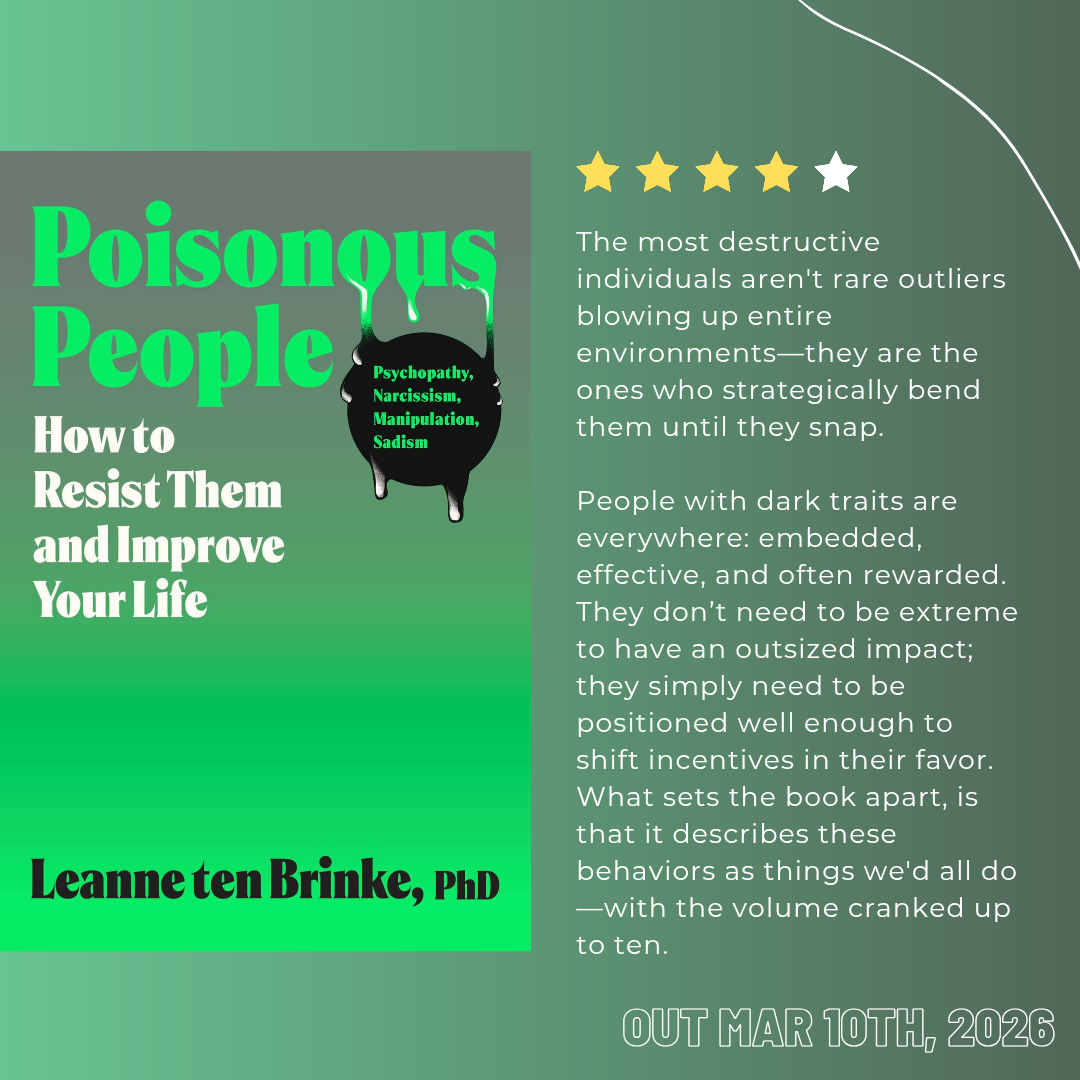
The most destructive individuals aren't rare outliers blowing up entire systems—they are the ones who strategically bend them until they snap.
In Poisonous People, Leanne ten Brinke insists that people with dark traits are everywhere: embedded, effective, and often rewarded. They don’t need to be extreme to have an outsized impact; they simply need to be positioned well enough to shift incentives in their favor. What sets the book apart, is that it describes these behaviors as things we'd all do—with the volume cranked up to ten.
Like many, I had fallen into the habit of labeling these personalities simply as "narcissistic"—a term so popular it has lost its edge. This book provided a necessary correction, drawing a distinction between the mere need for admiration and the more calculated nature of psychopathic traits and Machiavellianism. Seeing these behaviors as strategic manipulation rather than just ego-seeking changed my perspective.
This hit home for me because it so clearly mirrors my decades in academia. In an environment where the pressure to be "special," to secure limited grants, and to be the absolute best is constant, those who operate with a Machiavellian desire to get what they want don't just survive—they thrive. Their pathological need to succeed at any cost allows them to navigate the system with a cold efficiency that others lack. It only takes a few such actors to distort the broader culture until the entire environment feels misaligned.
The resolution, however, is humble: there is no "fix," only management. Boundaries and pattern recognition are your only real shields.
Ultimately, recognizing this dynamic was why I chose to walk away from academia. There seemed to be no systemic fix—only individual management. While boundaries and awareness are necessary, I realized I needed an environment built on cooperation and kindness, not one that required constant, energy-intensive avoidance. In this regard, Poisonous People didn't tell me anything I didn't already know, but it was deeply validating.
In gratitude to Simon & Schuster for the Advance Reader's Copy.